
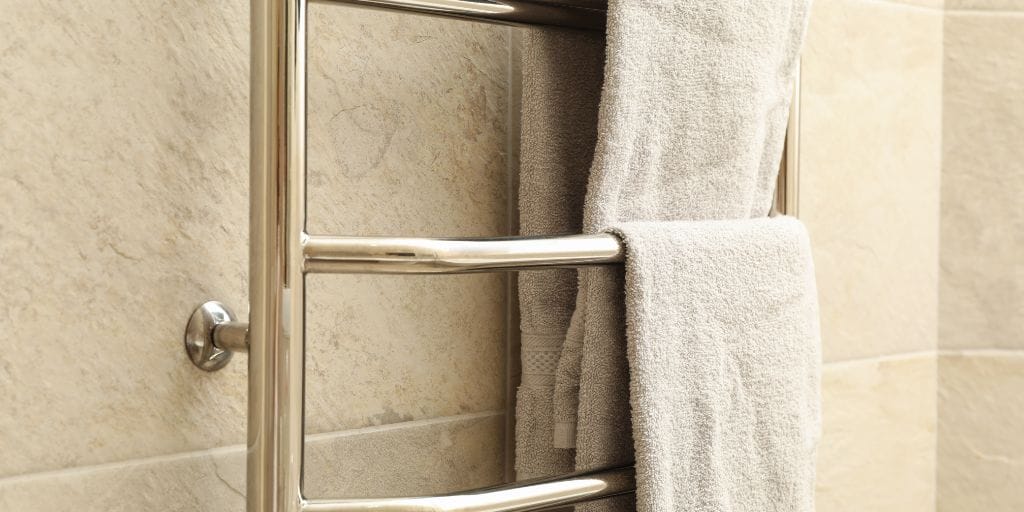
If you’re renovating a bathroom, the heated towel rail probably feels like it’s the easiest job on your list. All you need to do is pick a style, pick a colour, stick it on the wall and the job is as good as done.
Except it’s often the one thing people wish they’d thought about a tad more carefully. When a bathroom feels cold, nine times out of ten the issue comes back to the towel rail being undersized. And by the time you realise, everything’s tiled and decorated.
Why are heated towel rails important in bathroom design?
A heated towel rail isn’t just there to dry towels. In many bathrooms, especially ensuites, it’s the only heat source in the room. That means it has to warm the air, deal with moisture, and make the space comfortable on a cold morning.
The common mistake is treating it as a straight swap for a radiator. A radiator comes off the wall, a towel rail goes on in roughly the same space, and everyone assumes the heat output will be similar. In reality, radiators are designed purely to emit heat, whereas towel rails are designed to hold towels as well. That difference in design usually means a difference in output.
When you start thinking of the towel rail as part of the heating system rather than just a fixture, the decisions around size and placement make a lot more sense.
How to calculate the right heated towel rail size using BTU
This is where BTU comes in. BTU stands for British Thermal Unit, and it’s simply a measurement of how much heat a radiator or towel rail can produce. The bigger the number, the more heat it gives off.
While BTUs are still commonly referenced (especially in older guides and product specifications), modern heating systems are generally measured in Watts (W) or kilowatts (kW), which are the standard metric units for heat output.
To work out what your bathroom needs, you have to consider more than just floor area. The calculation typically takes into account:
- The room’s length, width and ceiling height
- Whether the walls are solid or insulated cavity walls
- The size and type of windows
- How many external walls the room has
A bathroom in a 1930s Coventry property with solid walls and a large window will lose heat much faster than one in a modern new build with good insulation. That difference directly affects the BTU requirement.
Using a BTU calculator before you choose your towel rail is essential. As a general rule, it’s wise to go slightly above the calculated requirement. If your bathroom needs 600 watts, installing something closer to 700 watts gives you flexibility. You can always turn the heat down, but you can’t increase output beyond what the rail is capable of. That small margin makes a noticeable difference in winter.
Common heated towel rail sizing mistakes
One of the biggest mistakes homeowners make is choosing a towel rail based purely on dimensions. Just because it fits neatly between two walls doesn’t mean it will heat the room effectively.
Another issue is not thinking about how the heating system is used day to day. In some homes, the heating runs on a timer morning and evening. In others, it’s turned on manually when someone feels cold. If you tend to use a boost-style approach, the bathroom needs to heat up quickly. An undersized towel rail may eventually warm the space, but not in the time you actually need it to.
Boiler settings and system balancing also play a role. If the upstairs radiators are already struggling to get hot, a small towel rail in a bathroom at the top of the house is unlikely to perform well. These practical realities matter more than showroom aesthetics.
Choosing the best heated towel rail finish for heat output
Finish isn’t just about appearance. It affects performance too. Chrome towel rails are popular because they look stylish, especially in modern bathrooms. What many people don’t realise is that chrome doesn’t radiate heat as efficiently as painted finishes. A white or coloured towel rail of the same size will typically produce noticeably more usable heat.
That doesn’t mean chrome is the wrong choice, but it does mean you need to factor that difference into your sizing. If your BTU requirement is already tight, opting for chrome without increasing the size can leave you short on warmth.
Black and coloured rails have become increasingly popular and often provide a good balance between design impact and output. In traditional bathrooms, column-style radiators with integrated towel bars can offer strong heat performance while still allowing towel storage.
Where should you position a heated towel rail in your bathroom?
Placement can either support or undermine your heating performance. Ideally, a towel rail should be positioned where it’s easy to reach from the shower or bath and where heat can circulate freely around the room. Installing it behind a door may look tidy on a floor plan, but restricted airflow reduces its effectiveness.
Positioning under a window is sometimes unavoidable, especially in smaller ensuites. Windows are natural cold spots, so if that’s your only viable wall, you may need to increase the rail’s output to compensate for the heat loss.
The important thing is to plan the towel rail location at the same time as the rest of the bathroom layout. If it’s left until the end, you often end up compromising on either performance or practicality.
Electric vs Central heating vs Dual fuel towel rails
When choosing a heated towel rail, you’ll also need to decide how it’s powered. A central heating towel rail connects to your boiler and heats up whenever the main heating is on. This works well in winter but can be less convenient in summer if you only want warm towels.
An electric towel rail runs independently, usually with its own timer or thermostat. It allows you to heat towels without turning on the entire heating system. Dual fuel models combine both options. They connect to the central heating but also include an electric element for use when the boiler is off. For many households, this offers the most flexibility throughout the year.
It’s also worth noting that underfloor heating, while comfortable underfoot, works differently to a towel rail. It can heat the room very effectively, creating a warm and comfortable space, but it won’t dry towels in the same way. Because the heat rises gently from the floor rather than being applied directly to the towel, drying is much slower compared to a heated towel rail.
When a radiator is a better option than a towel rail
In larger bathrooms or particularly cold spaces, a traditional radiator can sometimes be the more effective choice for heating the room. Radiators are designed to maximise heat transfer and often include convector fins that help distribute warmth more quickly. The downside, of course, is the lack of towel storage.
In some cases, the most practical solution is installing both a radiator for room heating and a smaller towel rail for convenience. This approach prioritises comfort without sacrificing functionality. It ultimately comes down to what matters most in your space: maximum heat output, towel storage, or a balance of both.
Final thoughts
A heated towel rail might look like just a finishing touch, but it plays a really important role in how your bathroom feels day to day. Choosing the right size, finish and position from the start prevents the frustration of a cold room later on.
Before making a decision, use a BTU calculator, think realistically about how your heating system is used, and consider how insulation and layout affect heat loss. If in doubt, slightly oversize the rail rather than cutting it fine.
Need more advice on your bathroom renovation? Contact our friendly team today. With over three decades of experience, we have the knowledge to help you choose the perfect heated towel rail, get the sizing right, and create a bathroom that’s both stylish and comfortably warm all year round.